
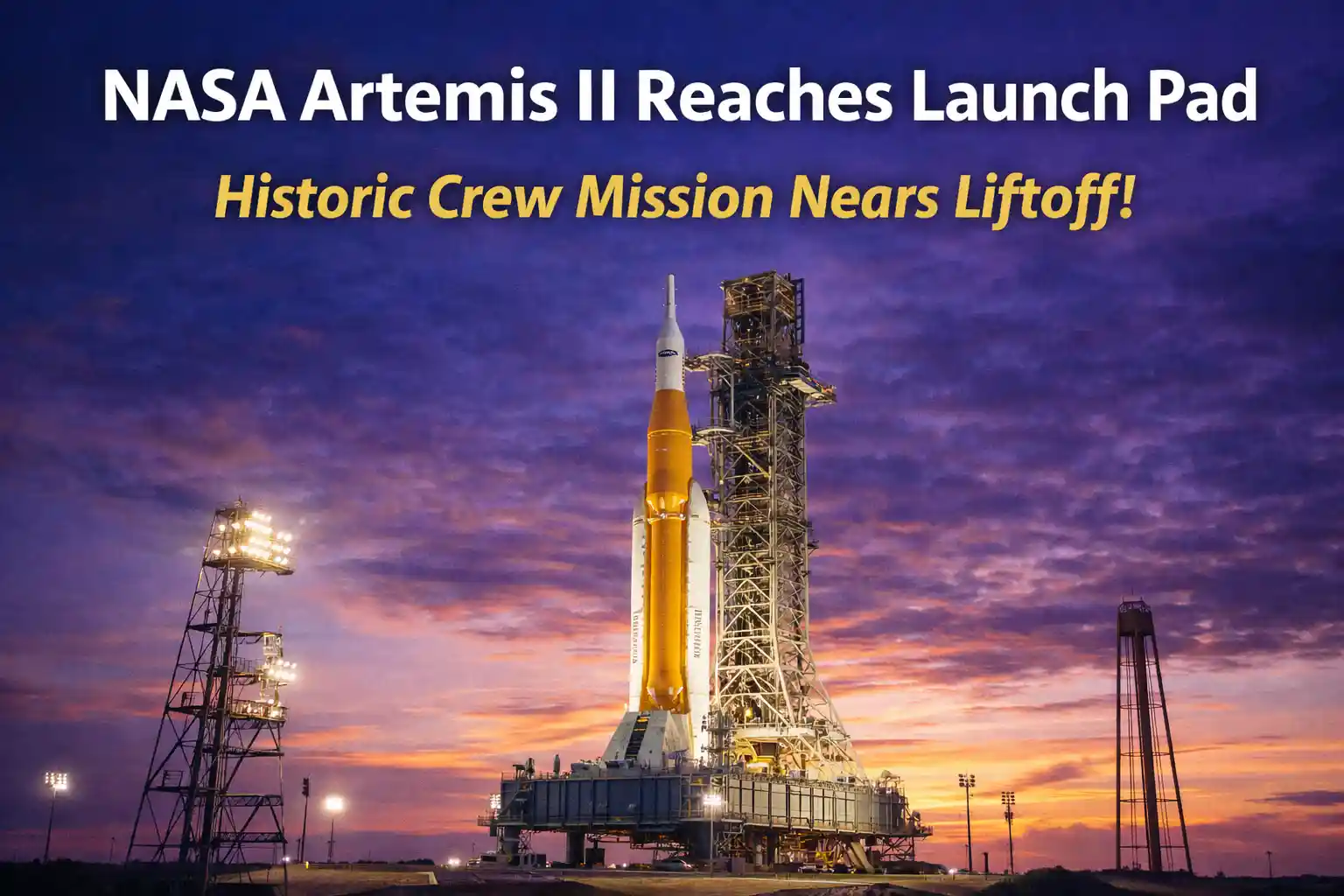
NASA’s Artemis II mission has reached a major milestone as the giant Space Launch System (SLS) rocket and Orion spacecraft have been rolled out to the NASA Artemis II launch pad at the Kennedy Space Center in Florida, signaling the countdown to the first crewed lunar mission in over 50 years. This critical step brings humanity closer to once again sending astronauts around the Moon and back.
Historic Move to the Launch Pad
On January 17–18, 2026, NASA transported the fully assembled Artemis II Space Launch System rocket and the Orion crew capsule from the Vehicle Assembly Building to Launch Pad 39B at Kennedy Space Center. The massive 322‑foot‑tall rocket covered nearly four miles at a slow crawl of less than 1 mile per hour on a mobile transporter before reaching the pad in the early evening.
This process took almost 12 hours and was witnessed by hundreds of NASA personnel, contractors, and supporters who gathered to watch the historic moment.
What the Artemis II Mission Entails
Artemis II is part of NASA’s long‑term Artemis program, which aims to re‑establish human exploration of the Moon and eventually prepare for missions to Mars. Unlike the uncrewed Artemis I mission, Artemis II will be the first crewed flight under the Artemis program.
Scheduled to launch as early as February 6, 2026, the mission will carry four astronauts — Commander Reid Wiseman, Pilot Victor Glover, Mission Specialist Christina Koch, and Canadian astronaut Jeremy Hansen — on a 10‑day journey that will take them around the Moon before returning to Earth. This “free‑return trajectory” ensures the capsule loops around the lunar far side and safely back toward Earth, testing life support, navigation, and spacecraft systems critical for future lunar landings.
Importance of the Launch Pad Preparations
Reaching the NASA Artemis II launch pad is a significant step but not the final one. Once at Launch Complex 39B, engineers and technicians will begin a series of preparations including integrated systems checks and a full “wet dress rehearsal,” where the rocket is fueled and the countdown sequence is practiced in real conditions.
This dress rehearsal, likely to take place before February 2, verifies the readiness of the spacecraft and ground support systems before an official launch attempt window opens. NASA has identified multiple launch windows through early April 2026, with the primary target in early February.
A New Era of Lunar Exploration
Artemis II represents more than a single mission — it is a critical proving ground for NASA’s human space exploration strategy. The data and experience gained from this flight will lay the groundwork for Artemis III, the planned crewed Moon landing scheduled for later this decade.
While Artemis II will not land on the lunar surface, it will send astronauts farther from Earth than they have traveled in over half a century, reviving human lunar exploration and inspiring a new generation of scientists, engineers, and explorers.
What’s Next
With the rocket now at the launch pad, NASA will move forward with final preparations and safety checks. Mission teams are focused on crew safety and system reliability as they approach liftoff. If all goes according to plan during the wet dress rehearsal and integrated countdown tests, Artemis II could launch as early as February 2026 — an historic moment for space exploration and human presence beyond Earth.